
Hampton Inn / American Express · Design and Development · 2013
20,000 personalized luggage tags. One Flash app. No team behind it.
- Problem
- Hampton's high-tier rewards travelers were an older demographic using the web in a limited capacity, so a multi-step personalization tool risked losing them at every panel.
- Solution
- Heavy wayfinding and a guided five-step flow carried users through background, message, photo, and shipping with enough signposting that the average tag took under two minutes to create.
- Stack
- A five-step Flash RIA with client-side ActionScript image compositing, font and color controls, and a PHP fulfillment pipeline driving print and mailing, built solo on 2013 connection speeds.
Hampton Inn and American Express wanted every guest to feel like the experience was designed for them specifically. The vehicle was a luggage tag. Custom background, personal message, their own photo if they wanted it. I designed and built the tool that made it possible, alone, start to finish.

20,000+
personalized tags delivered
<2 min
average time to create a tag
The brief
Two major hospitality brands. One shared belief: that a guest who feels seen stays again. Hampton Inn and American Express wanted to deliver something tangible to their travelers, something that would sit on the baggage carousel and remind them who cared enough to send it. The brief was a physical luggage tag, fully custom, mailed to the guest's door. My job was to build the tool that let them make one.
Designing for the traveler who barely uses the web
The reward went to Hampton's high-tier loyalty members, and that audience skewed older and used the web sparingly. A personalization tool that assumed fluency would have lost them at the first screen. Accessibility for that demographic was the central design constraint, not a finishing touch. The answer was wayfinding, everywhere. Each of the five steps made its job obvious, showed where the user was in the sequence, and made the next action the easiest thing on the screen. Nobody had to wonder what to do next or worry they'd broken something. The signposting did its job, guests moved through the whole flow and created hundreds of cards a day, with an average creation time under two minutes.
The tool
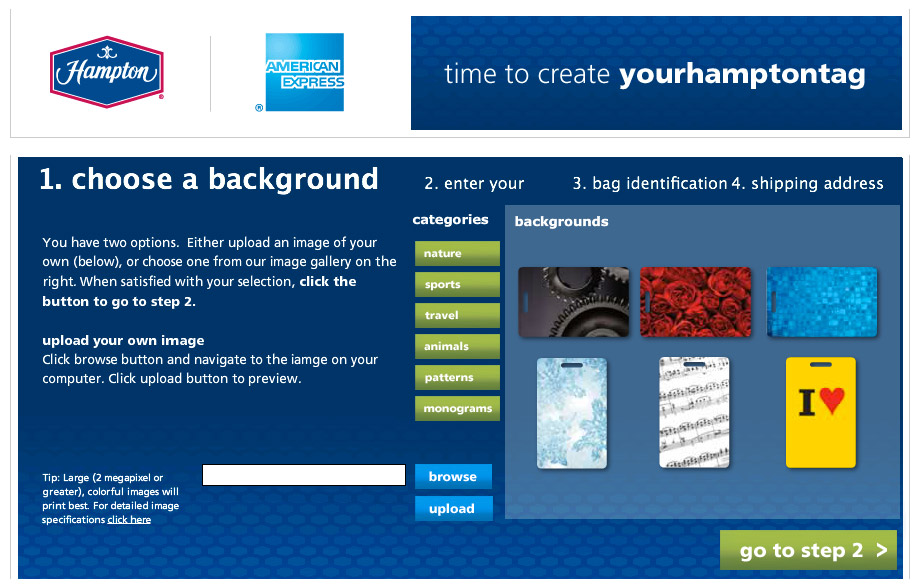
yourHamptonTag.com was a five-step Flash RIA. Guests chose a background from curated category galleries, or uploaded their own photo. They added a personal message, positioned it, flipped it, changed the font and color. Bag identification fields went on the back. A shipping address closed the loop. The whole thing fed a PHP fulfillment pipeline that handled print production and mailing.
Design and development, solo
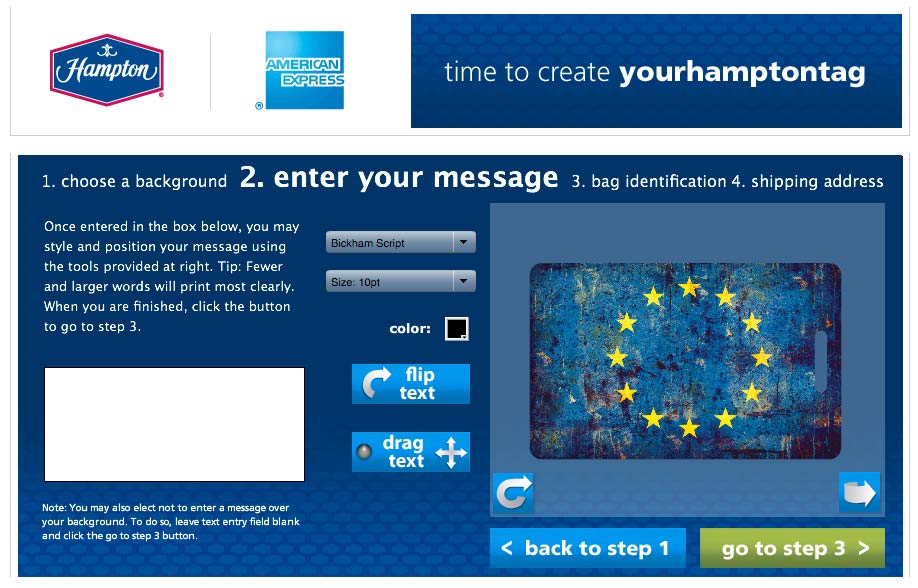
I was both the designer and the developer on this project. No division of labor, no handoff. Design decisions lived in the same head as the technical constraints. Image compositing happened client-side in ActionScript before the order hit the server. The upload flow had to handle arbitrary photos at print resolution without falling over. Text overlay had to look right at any position and any orientation. Getting all of that to work together, in Flash, on the connection speeds of 2013, was the actual challenge.
“My mom felt comfortable doing it.”
Outcome
By the end of the campaign, more than 20,000 guests had received a personalized luggage tag. The application ran without a major incident. It handled image upload and client-side compositing without a dedicated CDN or edge network. It was a small project by enterprise standards. It was also a complete one.
Next case study
Exosite
ExoSense